
Searching Liberty County Civil Dockets
Start with the Liberty Tyler CM Web Search, the clerk's public register for county cases. It lets you look up a civil case by party, associated party, or case number. Try every plausible spelling of a name; typos hide cases. Already have the number? The indexed form wants a court code, a division, and a year. The number itself goes in too. A dead form or failed redirect is not proof the case is missing. It just means you should try another channel, because the direct routes break from time to time. Before you search, gather full party names, an approximate year, and the likely court. Add any action number as well. One official calendar shows the pattern 2025-SU-V-537. That breaks into a year, a court code, then a serial number. Treat that as an example only. No single format governs every Liberty County civil docket.
- Identify Superior, State, Magistrate, or Probate jurisdiction before opening the register.
- Choose party search when the action number is unknown, and try name variants.
- Use the case-number path when the year, court code, and number are available.
- Confirm the party roles, cause of action, filing date, and court on a likely match.
- Read service, motions, orders, settings, and disposition in date order.
- Ask the Clerk for the filed paper or certified judgment when the register only names the event.
Liberty County Civil Docket Routing
Civil cases in Liberty County split by jurisdiction, not by rival clerks. Superior Court takes divorce and other domestic matters. Equity, title-to-land disputes, and the major civil cases land there too. State Court picks up civil work that Superior Court does not claim. Magistrate Court covers claims up to $15,000 in most instances. It also handles garnishments, personal-property foreclosure, abandoned vehicles, and other lower-court matters. Probate Court runs its own office for estates, guardianships, and conservatorships.
| Court | Civil docket focus | First contact |
|---|---|---|
| Superior | Divorce, equity, land title, domestic and major civil claims | Liberty County Clerk of Courts |
| State | Civil matters not reserved to Superior Court | Liberty County Clerk of Courts |
| Magistrate | Claims generally through $15,000 and listed lower-court remedies | Magistrate Court or unified Clerk |
| Probate | Estates, guardianships, and conservatorships | Separate Probate Court office |
Ordinary county civil claims do not land in a city municipal court. If Tyler returns no match, check the amount and the subject of the action before searching again.
Inside a Liberty County Civil Docket
Rule 39.2 is the strongest official guide to reading a Liberty County civil docket. It covers far more than a case caption. The register can show the action number, cause, lawyers, parties, filing and service, costs, the type of disposition, trial facts, appeal steps, and where an older file sits. One caution applies. An entry on the docket does not mean its document image is open online.
| Identity | Action number, parties, attorneys, cause of action, filing date, and assigned court. |
|---|---|
| Service and cost | Service date and type, advance costs, and later costs entered in the register. |
| Filings | A dated summary of pleadings, transcripts, new-trial motions, and notices of appeal. |
| Outcome | Settlement, dismissal, judgment, transfer, administrative termination, verdict, or mistrial. |
| After judgment | Fi. Fa., transcript, appeal, remittitur, minutes, final record, and storage cross-reference. |
The official civil pretrial calendar adds report time, court, judge, setting time, item number, case time, remarks, and party-role blocks. So a single line can carry more detail than a docket entry alone. What the live Tyler result screen offers, including its buttons and image links, only shows up when a search actually loads.
Liberty County Civil Docket Filing
PeachCourt is the mandatory civil e-filing provider for Liberty Superior and State courts. It does not replace Tyler's public case register. One official civil calendar carried a remark that a case had been created from a PeachCourt import. That shows the filing and calendar systems talk to each other, but they still do different jobs. The official PeachCourt page below shows the civil filing channel assigned to this Liberty County civil docket page.

Use the filing portal to submit eligible papers. For public docket review and certified records, Tyler, the calendar, and the Clerk remain the practical routes. Georgia Courts also publishes an e-file directory listing participating courts. That directory shows Liberty State and Superior filing access.
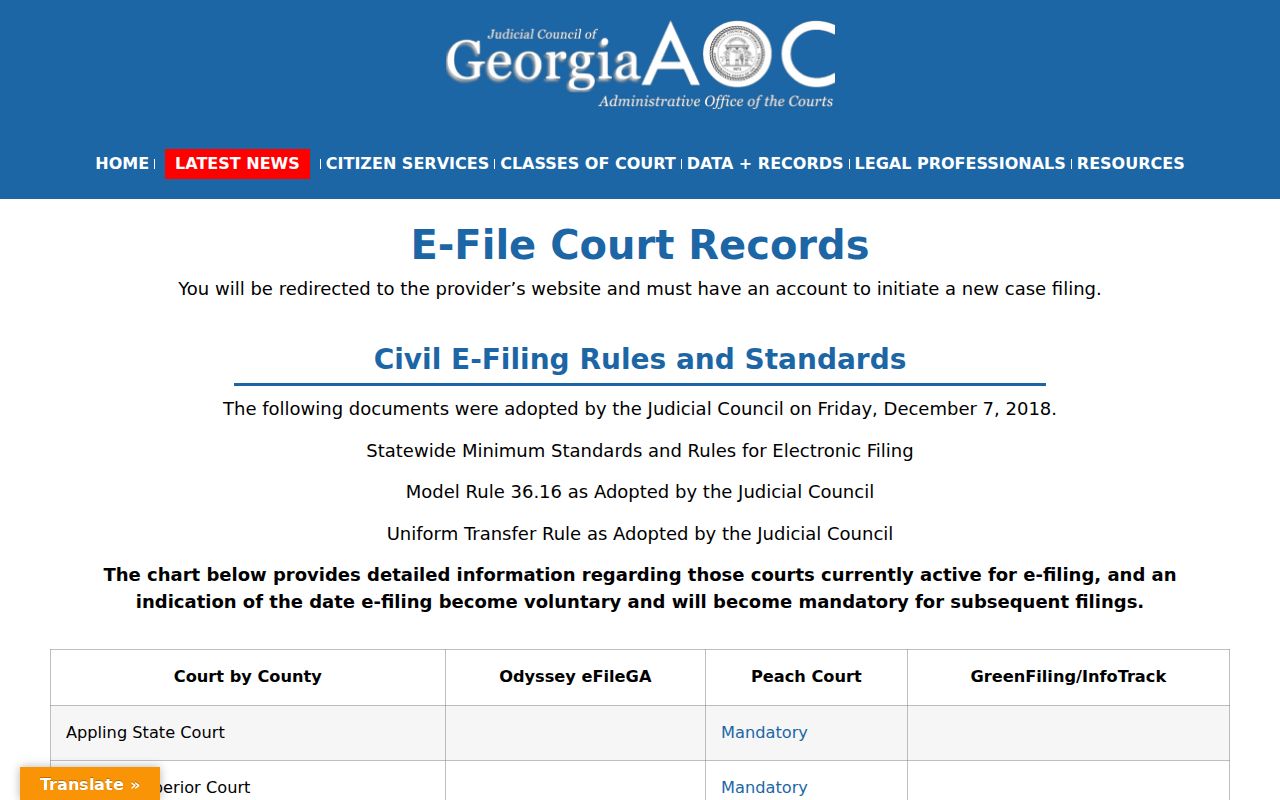
The directory routes filers to a provider. It is not a statewide public docket database, and no statewide search replaces Liberty's local register.
Civil Case Types on the Docket
Finding the right Liberty County civil docket takes two things. It depends on the subject. It also depends on the relief sought. Superior Court holds exclusive or broad authority over key family, equity, and land matters. State Court receives other county civil actions within its jurisdiction. Magistrate Court offers a lower-court path for its listed claims. Probate keeps a specialized file outside the unified clerk structure.
- Superior civil and domestic matters, including divorce, equity, title to land, and related relief.
- State Court civil cases not reserved by law to Superior Court.
- Magistrate claims generally up to $15,000, plus garnishment and listed property remedies.
- Probate estates, guardianships, and conservatorships through the separate Probate office.
- Appeals or transfers from lower courts, shown through notices, transcripts, remittiturs, and cross-references.
A transfer entry means the record may continue under another court. Follow the new action number or cross-reference instead of assuming the first docket holds the final result.
Liberty County Civil Docket Claims
The $15,000 claim ceiling is the clearest local routing marker. Liberty Magistrate Court handles qualifying claims through that amount. The court also publishes its own Tyler/JusticePlus civil e-filing path. Its filing disclaimer states that a $15 convenience fee applies per filing. The fee is not restored if a filing is rejected. The service requires suitable document tools. The court's warning deserves a read before you submit anything. The Liberty Magistrate e-filing disclaimer is the page that shows this filing path.
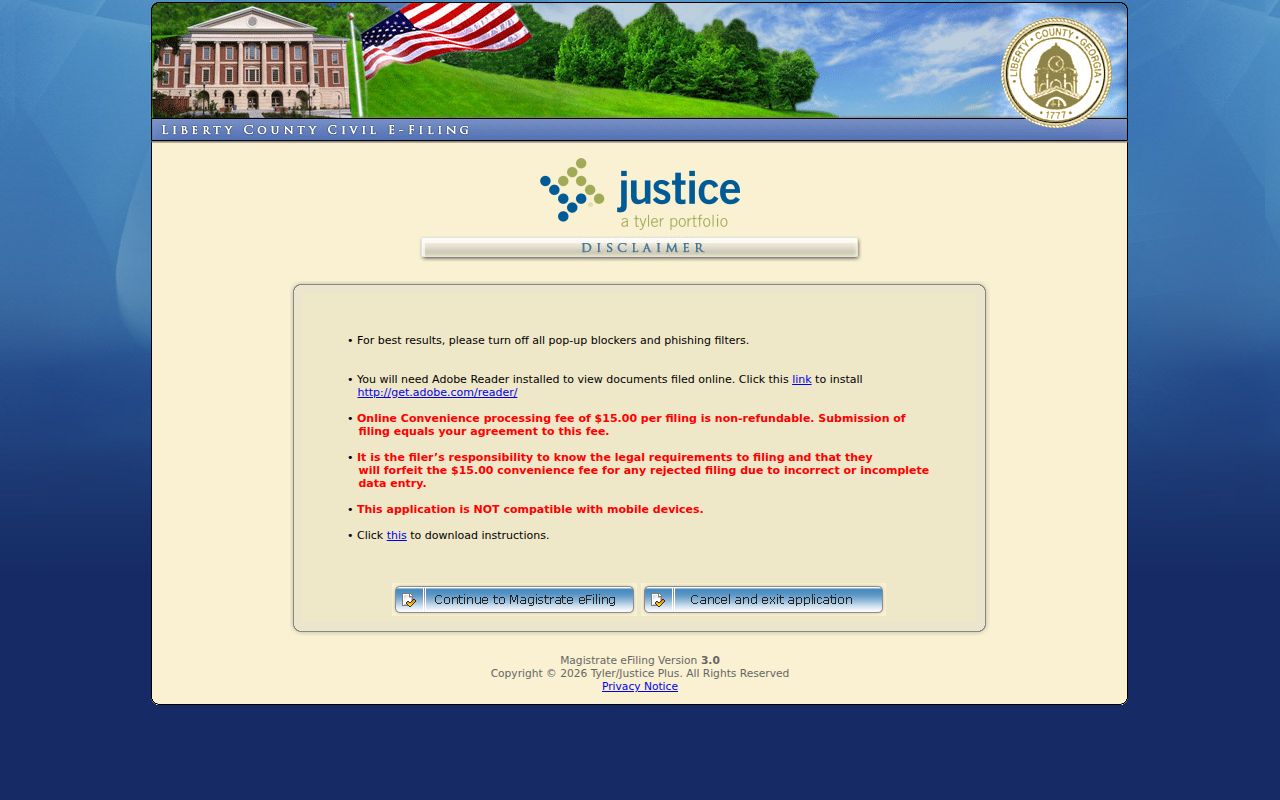
The page helps a filer tell an e-filing charge apart from public docket viewing, which carries no viewing fee. The official Magistrate claim information covers the claim limit, filing, answer, transfer, and hearing steps.
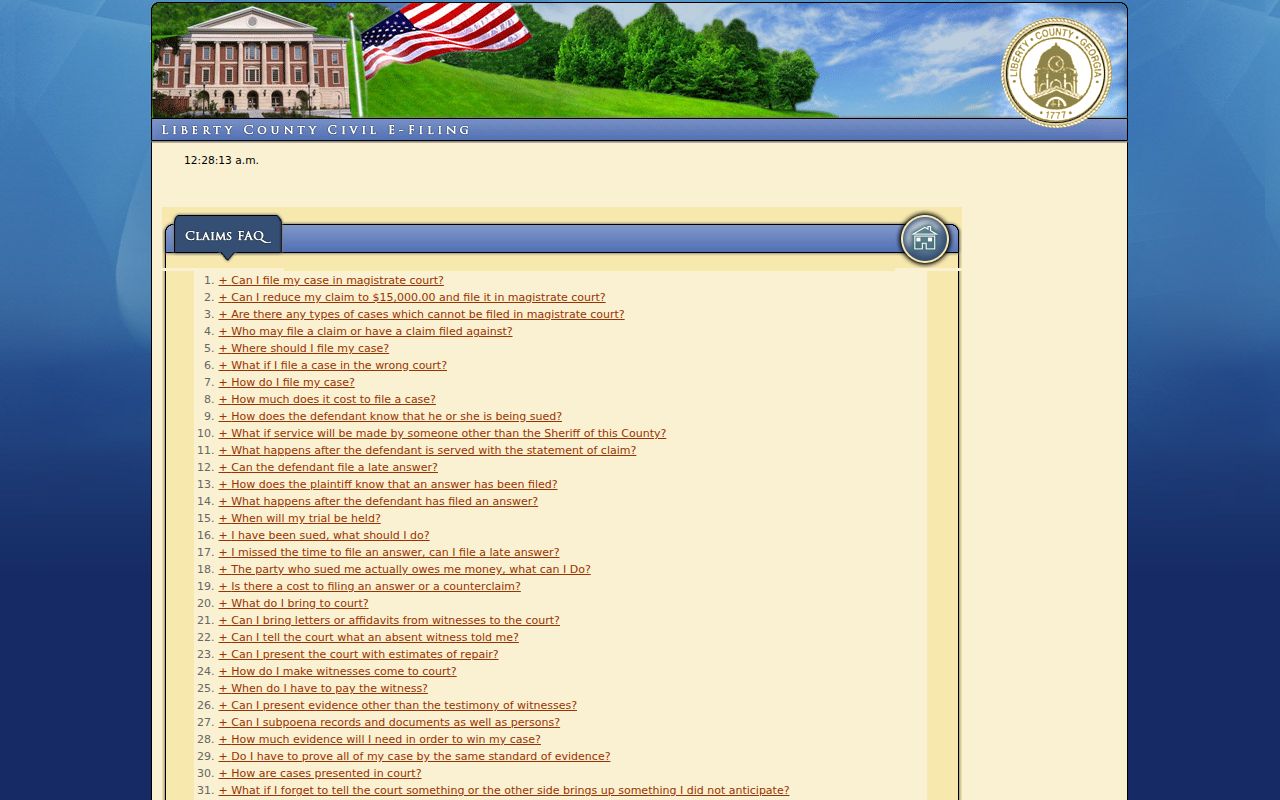
This local guidance helps a reader decide whether a Liberty County civil docket should begin in Magistrate Court, and what may happen after an answer or a transfer.
Civil Docket Settings and Hearings
Start with the Liberty County calendar hub, which posts weekly and court-specific PDFs for settings such as Superior Civil Non-Jury and State jury weeks. Each civil calendar is dense with detail. Look for the report date, court, judge, calendar title, hearing date and time, item number, action number, cause of action, filing date, case time, remarks, and party roles. It helps you track settings. It is not the full civil register for Liberty County.
Read the entries in order. Filing creates the case, and service shows formal delivery. A motion asks the judge for relief. An order records the ruling, and a continuance or reset moves the setting to a new date. Dates shift often, so the county's calendar page warns users to compare the newest calendar against the latest signed order and to confirm any required appearance with the Clerk or the court office.
Remember that a setting is not a judgment. A pretrial calendar may organize the issues before trial, while a non-jury setting flags court business a judge will hear alone. The civil docket outcome comes later, and it may show settlement, dismissal with or without prejudice, default judgment, a trial result, or administrative termination.
Liberty County Civil Docket Outcomes
Read outcome language with care. A dismissal with prejudice generally bars refiling the same claim. One without prejudice does not. A default judgment can follow when a party fails to respond as required, and settlement means the dispute ended by agreement rather than a contested verdict. A Fi. Fa., short for fieri facias, is a writ used to record or enforce a money judgment in a Liberty County civil docket.
- Service
- Formal delivery of the summons, pleading, or other paper, with date and type tracked on the docket.
- Order
- A judge's directive that may decide a motion, change a date, or resolve part of the case.
- Judgment
- The court's formal decision, which is distinct from the docket line that notes it.
- Remittitur
- The entry showing that an appeal has returned to the trial-court record.
When the exact wording matters, ask the Clerk for the complaint, answer, order, or judgment itself. A register summary or an uncertified printout may not satisfy a formal filing need.
Civil Docket Access Rules
The Liberty County Clerk of Courts maintains Superior, State, Magistrate, and Juvenile files. Try Tyler first. You can also use the public terminal or the front counter at 201 South Main Street, Suite 1200, Hinesville, Georgia 31313. Call the unified Clerk line at 912-876-3625 or email clerk@libertycountyga.gov. Magistrate Court lists 912-368-2063. The separate Probate office lists 912-368-2063 and 912-876-3635.
Those are the practical routes to a civil docket. They run through the terminal, counter, phone, and email. Mail and fax details vary among official pages, so confirm them before sending anything.
Uniform Superior Court Rules 21 and 21.6 govern access limits, seals, and protected identifiers. Juvenile, adoption, sealed, and protected family records can be withheld or released only in part. Sensitive images may stay unavailable even when a docket header is public. Georgia's Attorney General puts court records under court inspection procedures. They fall outside an ordinary agency request under the Georgia Open Records Act.
Public docket, filed paper, certified copy:
The docket lists events. The filed paper contains the actual claim, response, motion, order, or judgment. A certified copy is authenticated by the Clerk for a use that needs official proof.
For older files or missing images, give the Clerk the court, the year, the action number, the document title, and the filing date. Say whether you need a plain or certified copy. No single online image price, bulk export, processing time, or identification rule applies across offices. Ask for a current quote before you pay.
Missing Liberty County Civil Dockets
A failed Liberty County civil docket lookup can stem from the wrong court, a name variant, an older off-site file, a transfer, a seal, or a specialized Probate matter. Try alternate spellings, and double-check the year and court code. Then call the proper office or use the courthouse terminal. Never read a blank portal response as a final finding.
If the register shows the event but not the paper, request the exact complaint, answer, motion, order, or judgment by name. PeachCourt and JusticePlus accept filings in their covered civil courts, yet neither proves that every public image can be opened there. The Liberty County Clerk's Judicial Division holds the county's unified court records and can tell you whether a file is online, at the counter, off-site, or access-limited.