
Liberty County Court Calendars Explained
The Liberty Clerk of Courts runs the official Court Calendars page. It serves Superior and State Court business. From it you can open a weekly master calendar. You also get the annual Atlantic Judicial Circuit combined calendar. Separate PDFs cover criminal non-jury, plea and motion, civil non-jury, Rule 20, jury trial, arraignment and bench trial, pre-trial diversion, and calendar call. Each report has its own job. None is a searchable calendar database.
The hub asks visitors to refresh the browser. It also warns that parties, counsel, and subpoenaed witnesses should not lean on the calendar by itself. A filed notice, citation, signed order, or direct confirmation can control. That holds true even when an older PDF tells a different story. Liberty County court dates may also surface in the Tyler case register. They can appear on a courthouse terminal, or with whichever office set the hearing.
The official calendar hub, reached through the link above, lays out that split plainly. Its court-specific links help you pick the right report for the setting you need.
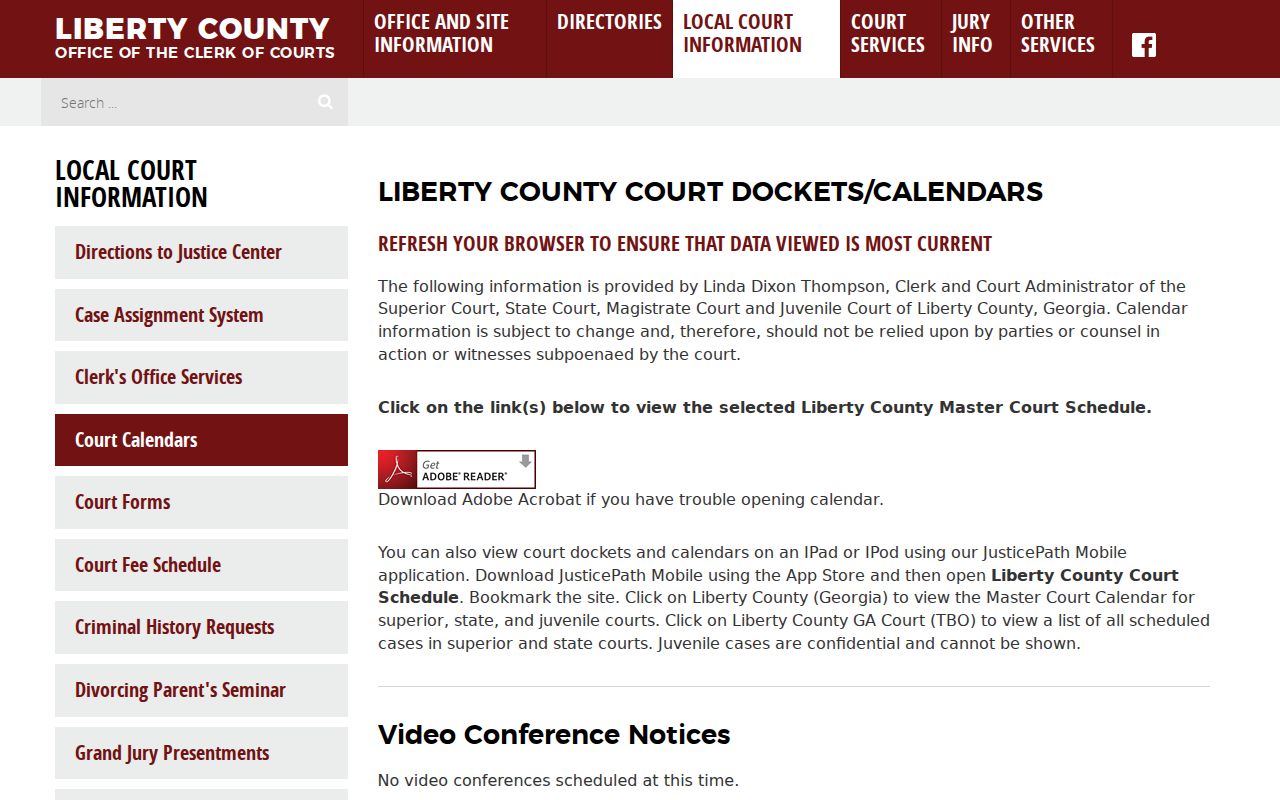
A posted calendar works as an index, nothing more. The latest court record and a direct confirmation still matter most.
Liberty County Weekly Court Calendar
The Weekly Master Calendar gives a broad look at county events. The annual combined calendar adds month-by-month dates for the Atlantic Judicial Circuit. That circuit covers Liberty County and five neighboring counties. Neither one replaces the court-specific report. Someone with a civil non-jury matter should open that calendar. A criminal plea or motion belongs in the matching judge-specific PDF.
This split keeps one crowded list from mixing unlike settings. It also sets a trap. A master schedule can show court in session without proving your case is still set. So read the court name, calendar title, judge, hearing date, and case number as one package. If any field clashes with the latest notice, call the responsible office before you appear.
Finding Your Court Date
Start with the paper that created the duty to appear. It names the court and often carries the case or citation number. Then work through every useful channel.
- Read the citation, summons, notice, or latest signed order and record the court, date, time, hearing type, and location.
- Open Tyler CM Web Search and inspect the newest setting or order if the public route loads.
- Compare that entry with the correct weekly or court-specific PDF and with JusticePath.
- Call the Clerk at 912-876-3625, Magistrate Court at 912-368-2063, or the issuing municipal court.
- Use the Justice Center public terminal or Suite 1200 counter when the web route fails or the case is old.
- Ask counsel about any filed order that changes the setting, then confirm again close to court.
Probate, confidential Juvenile, and municipal dockets do not share one public path. Each city clerk keeps its own municipal docket. Confidential Juvenile details cannot appear in the public scheduled-case view.
Liberty County JusticePath Court Dates
JusticePath Mobile is the clerk-published mobile option. The official JusticePath announcement describes free access to court events. Inside the app, choose "Liberty County (Georgia)" for the Superior, State, and Juvenile master calendar. Pick "Liberty County GA Court (TBO)" for scheduled Superior and State cases. TBO is a product label, not a proven disposition code.
The announcement, at the link above, presents the service as one more route. It leads to calendar information.
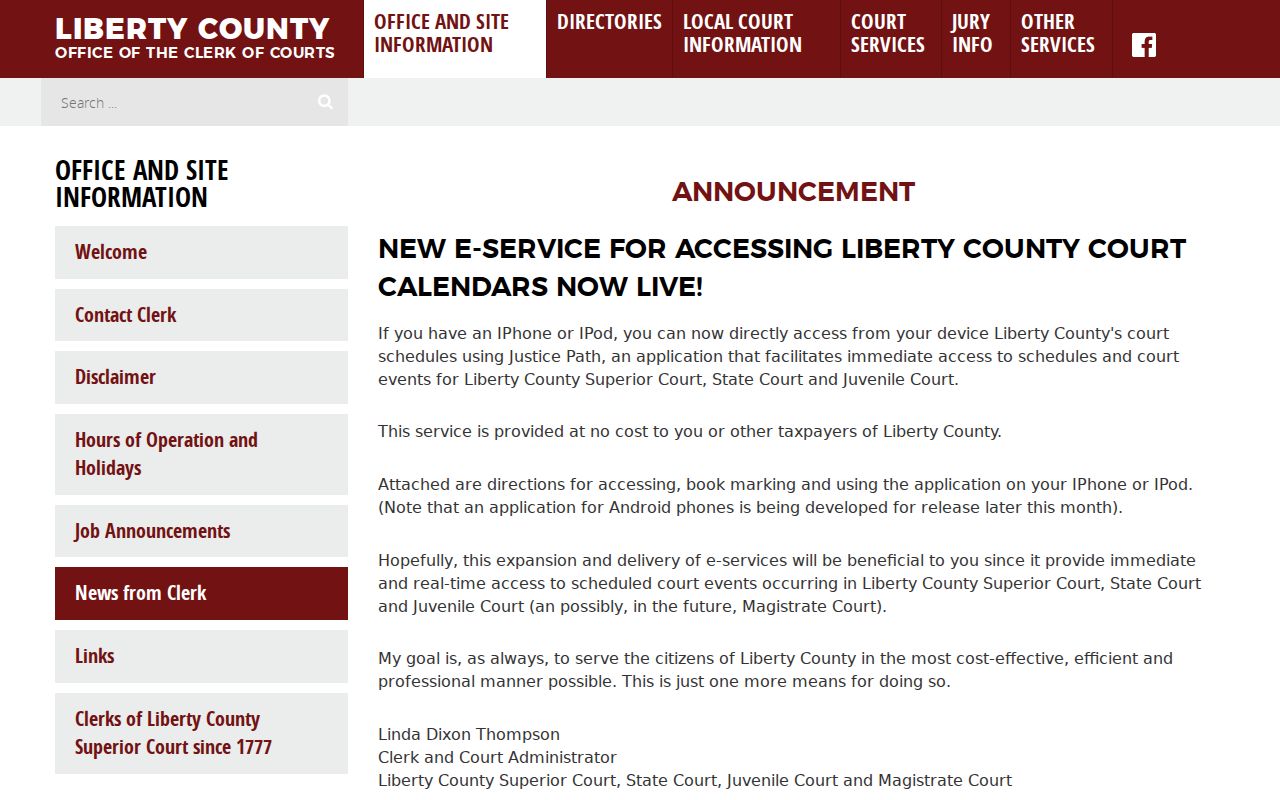
JusticePath is handy, but it cannot override a filed order or lift confidentiality limits. Juvenile case details stay out of public display.
How to Read a Court Setting
Read a setting as a set of fields that work together. The setting type tells you why the case is listed. The judge and court locate the session. An item number marks a place in the report. It is not the case number.
| Date | The scheduled day, subject to a later order, reset, or amended report. |
|---|---|
| Time | A calendar-call time or case time. Confirm which controls arrival. |
| Courtroom | The location or room for the session. |
| Judge | The judicial officer assigned to that calendar. |
| Setting Type | Arraignment, bench trial, plea and motion, civil non-jury, diversion, or Rule 20. |
| Case Details | Item number, case number, style, cause or charge, filing date, and remarks. |
Rule 20 is Liberty Superior Court's pretrial calendar-call step before jury selection. Civil non-jury puts the matter before a judge alone. Pre-trial diversion is a State Court program calendar, so confirm its terms with that court.
Liberty County Jury Court Status
A jury summons calls for a second check. The Clerk's jury trial status page posts live selection and trial information. It covers grand jury and Superior criminal or civil sessions. A summoned juror can learn from this table whether a listed event is going forward. It is not a party's case register.
That split is why Liberty County court dates can demand both checks. One is a case check. The other is a jury-status check.
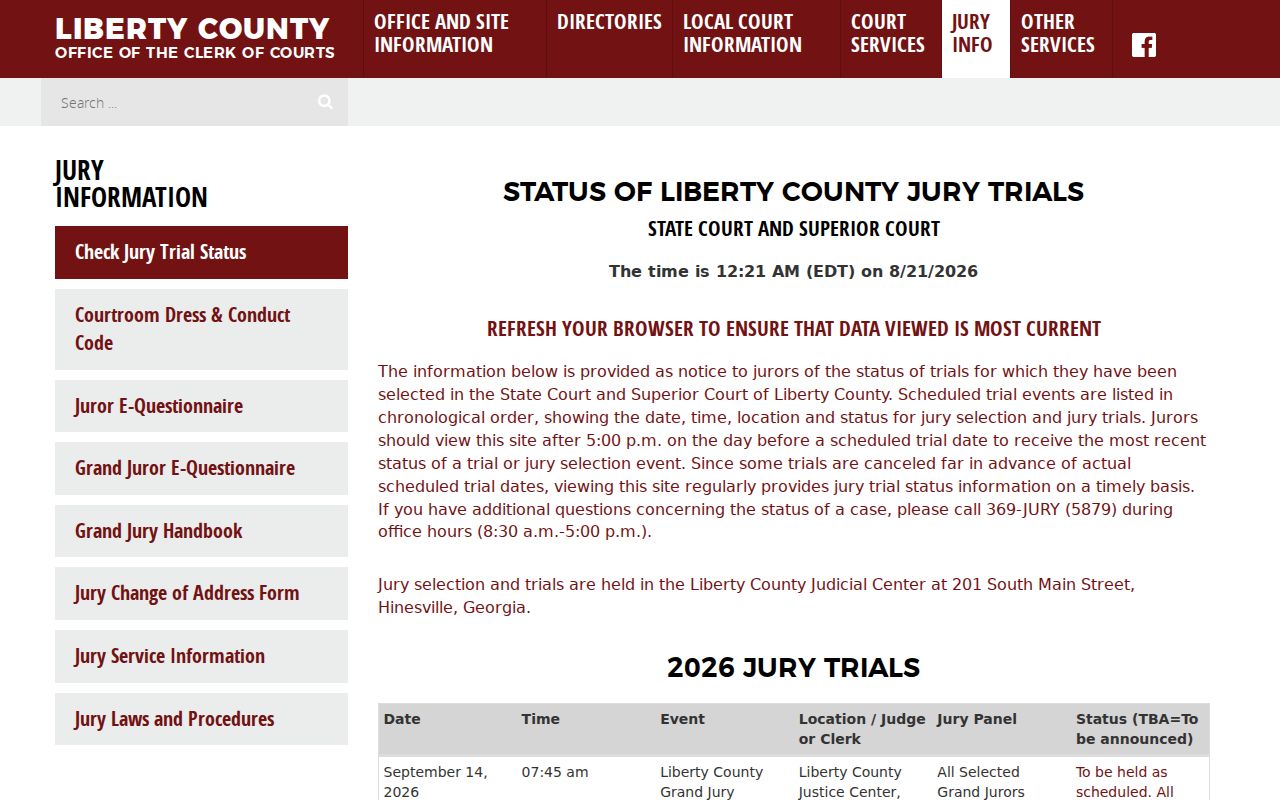
Jurors should follow the summons and current instructions. Parties should still confirm the case setting through the docket, attorney, or court office.
Continuances, Resets, and Cancellations
A continuance shifts a hearing to a later date. The reset is that new setting. Liberty County publishes no universal reset code or single deadline for all courts. A newer order, amended calendar, or later docket entry can supersede the date first shown. A saved PDF left open can miss that change entirely.
Refresh the page, then compare the newest entry against the last signed order. A report that vanished does not mean the case was cancelled. Call the court that owns the case. Hinesville Municipal Court runs its own postponement process. That city rule has no power over Liberty Superior or State Court.
Liberty County Closure Date Checks
Closures are one more reason to check before you go. The Clerk's hours and holidays page lists holiday and in-service days when the counter closes. Office hours sit on that page too. The clerk keeps those schedules apart from the court docket itself, so an open counter still tells you nothing about a hearing.
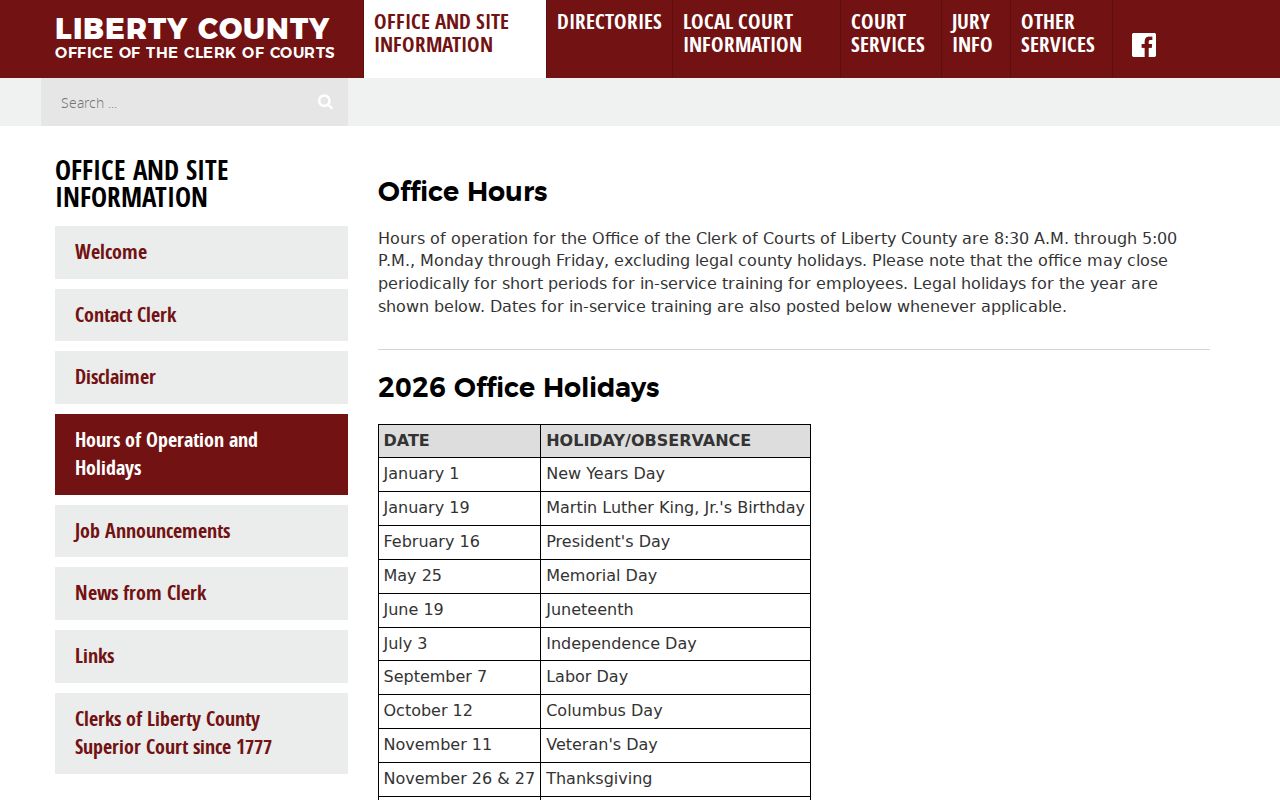
One caution is worth keeping in mind. A closed office does not mean your hearing moved, so confirm the setting with the court rather than assuming the holiday schedule changed a judge's order.
If You Miss a Court Setting
A missed Liberty County court date needs fast action. Call your attorney first if you have one. If not, phone the clerk or the specific court, give the case number and hearing type, and ask what the docket shows now. Do not show up at a later calendar call on your own without instructions.
Missed a Setting? A missed required appearance can trigger serious case consequences, including a bench warrant or action against a bond.
Contact the responsible Liberty County court or your lawyer promptly and ask how the new status must be addressed.
Legal advice about a warrant or bond must come from a licensed attorney, not from a calendar entry.
Confirm Liberty County Court Dates
Two sources beat one when confirming a Liberty County court date. Compare the newest register entry against the right calendar. Then verify with the clerk, the court office, or counsel. Have the court name, case number, party name, approximate year, and setting type ready. Those details let staff pull the correct court record fast.
Need a face-to-face option? The Justice Center counter at 201 South Main Street, Suite 1200, Hinesville, has public terminals for local case lookup. Staff help is limited there, though. Older, sealed, Probate, Juvenile, and municipal matters may take a different route. For a broader name or number search, try the Liberty County case lookup.
Liberty County Setting Cross-Check
Before you rely on a date, cross-check five things: the court, the case number, the date, the time, and the event type. Any mismatch means the setting is unresolved. You should call the office that keeps the docket. This quick comparison matters most after a continuance, a holiday closure, or a browser redirect.
Keep your notes with the notice or citation. Writing down which office you called and the current setting can save confusion later. But only the court record and authorized court instructions actually control.