
Searching Liberty County Criminal Dockets
Start at the clerk's own portal, the Liberty Tyler CM Web Search. The home screen gives you three doors: Search By Party, Search By Associated Party, and Search By Case Number. A name works when you lack the number. Try each likely spelling. The county itself warns that its public data may not be complete or fully current. And a blank or redirected screen is not proof that no Liberty County criminal docket exists, since the direct search routes can bounce back to the home screen. Pick up the phone instead.
Before you type anything, settle the likely court. A felony normally lands in Liberty Superior Court. A county misdemeanor usually belongs to State Court. Warrant and probable-cause matters often begin in Magistrate Court, while a city citation stays with its municipal clerk. Gather the defendant's full name, the rough filing year, the court, and any indictment, accusation, citation, or case number.
- Open Tyler CM Web Search and read the public-record disclaimer.
- Choose party, associated-party, or case-number search based on the facts known.
- For a numbered search, select the court code and division, then enter the required year and number if the form loads.
- Match the court, case number, filing date, charge, and party role before relying on an entry.
- Read events in date order, then confirm the newest hearing or outcome with the Clerk.
Liberty County Felony Docket Routing
Jurisdiction drives the whole search path. Felony trials belong to Superior Court, as the Georgia Courts jurisdiction guide explains. Liberty State Court takes countywide misdemeanors and traffic matters outside a city court. Warrants, pre-warrant applications, probable-cause hearings, and other pre-indictment work run through Magistrate Court. Those early Magistrate entries are not the same thing as a later Superior Court felony docket.
City halls keep their own records. Hinesville, Walthourville, Midway, and Allenhurst each have separate court channels for ordinance and city-traffic cases. Tyler may return no match. Ask whether the event stayed with a city clerk. Or did it begin only as a Magistrate warrant? Liberty County's unified Clerk maintains Superior, State, Magistrate, and Juvenile records; city clerks keep city dockets. Juvenile access is limited.
Inside a Liberty County Criminal Docket
Georgia's Rule 39.3 offers the most reliable model of what docket fields look like. A Liberty County criminal docket can track the charging paper, each count, counsel, pleas, settings, rulings, sentence, warrant activity, and appeal events. The public calendar adds practical setting fields. Keep one caution in mind. A docket entry may identify an event. It may not show the filed image behind it.
| Case identity | A unique indictment or accusation number, filing date, court, division, defendant, and OBTS number. |
|---|---|
| Charge block | Each count, offense type, felony or misdemeanor class, and a citation number when a traffic ticket is docketed. |
| Plea and settings | Plea and plea date, proceedings, motions, judge, calendar type, hearing date, and case time. |
| Disposition | Sentence date and type, terms, conditions, costs, fines, restitution, and final-disposition judge. |
| Later events | Bench-warrant return, transcript, sentence review, notice of appeal, remittitur, and storage cross-reference. |
Tyler screens vary in what they reveal. Result buttons, status labels, pagination, and image-link behavior differ from case to case. Treat these official fields as a reading checklist, not a promise that every field appears on every public screen.
Liberty County Criminal Docket Terms
Small labels do heavy lifting here. An indictment is a formal felony charge returned by a grand jury. An accusation is a prosecutor-filed charging paper. It is common in misdemeanor cases. OBTS stands for Offender Tracking Number and appears in the criminal docket rule's final-disposition data. A remittitur marks an appeal coming home to the trial-court file.
- Calendar call
- A pretrial event used to organize cases before trial, including Liberty Superior Court's Rule 20 process.
- Disposition
- The recorded outcome of a count or case, which may include a plea, dismissal, judgment, or sentence.
- Bench warrant
- A warrant issued by a judge, including one tied to a missed required appearance.
- Continuance or reset
- A move to a later setting. The newest order and calendar entry should be checked.
How a Criminal Case Moves
A case opens with a warrant, pre-warrant application, accusation, or indictment. The Clerk assigns a number and filing date. The charge block lists each count and its class. Arraignment follows. A plea and date may be entered there. Motions, orders, calendar calls, and resets appear in date order. A plea or trial moves the file toward disposition and sentencing. An appeal adds transcript, notice, and remittitur entries.
Docket flow: Filing › Arraignment › Pretrial › Plea or Trial › Disposition › Sentencing
A case number alone proves nothing about guilt. Read the count-level plea and the final disposition. Financial terms may appear on the register, though a public calendar can omit them. For formal proof, request the actual disposition or a certified copy from the Liberty County Clerk of Courts.
Liberty County Criminal Docket Calls
The Liberty court calendar hub splits its schedules by purpose: criminal non-jury, plea and motion, Rule 20, jury, arraignment, bench-trial, and pretrial-diversion calendars. That label tells you why the setting exists. Calendars change, the page warns. Refresh it and compare the PDF against the most recent signed order or register entry.
One Rule 20 sample told defendants and counsel to attend both calendar call and jury selection and limited continuances under that sample's terms. That sample does not set a universal rule for every criminal setting. Check the exact notice for your case. The calendar can show court, judge, date, time, item, case number, charge, and remarks. It is not a certified disposition.
Courts That Hold Criminal Dockets
Three courts split the criminal work in Liberty County. Liberty Superior Court takes felony indictments and the proceedings that follow them. State Court handles misdemeanors and nonmunicipal traffic cases countywide. Magistrate Court deals with warrants and early criminal proceedings. One office backs all three: the Liberty County Clerk of Courts, through the county's one-door system. Its Judicial Division description lists what the office does with criminal and civil records: receive, file, store, retrieve, and make them available.
Need something in person? Visit the Liberty County Justice Center at 201 South Main Street, Suite 1200, Hinesville, Georgia 31313. That Suite holds the front counter and the public terminal. You can also call 912-876-3625 or email clerk@libertycountyga.gov. Magistrate Court sits in Suite 2100 and lists 912-368-2063. For a municipal matter, go to the city court that issued it. These contacts earn their keep when the web register redirects you, when a file is old, or when staff need to sort out which division owns the criminal docket.
Liberty County Criminal Docket Copies
Liberty County draws a firm line on criminal-history help. The public terminal lets you pull local criminal data with little staff assistance. Clerks will not run a general criminal-history search. Instead, a request for a disposition should name a specific defendant and a specific criminal case. That framing keeps your ask inside the court record system. It is not an open-ended name check.
The official Liberty criminal-record policy sets out these rules in full. Reading it clarifies why the terminal, a targeted docket request, and a clerk-certified disposition count as three distinct services with different limits.
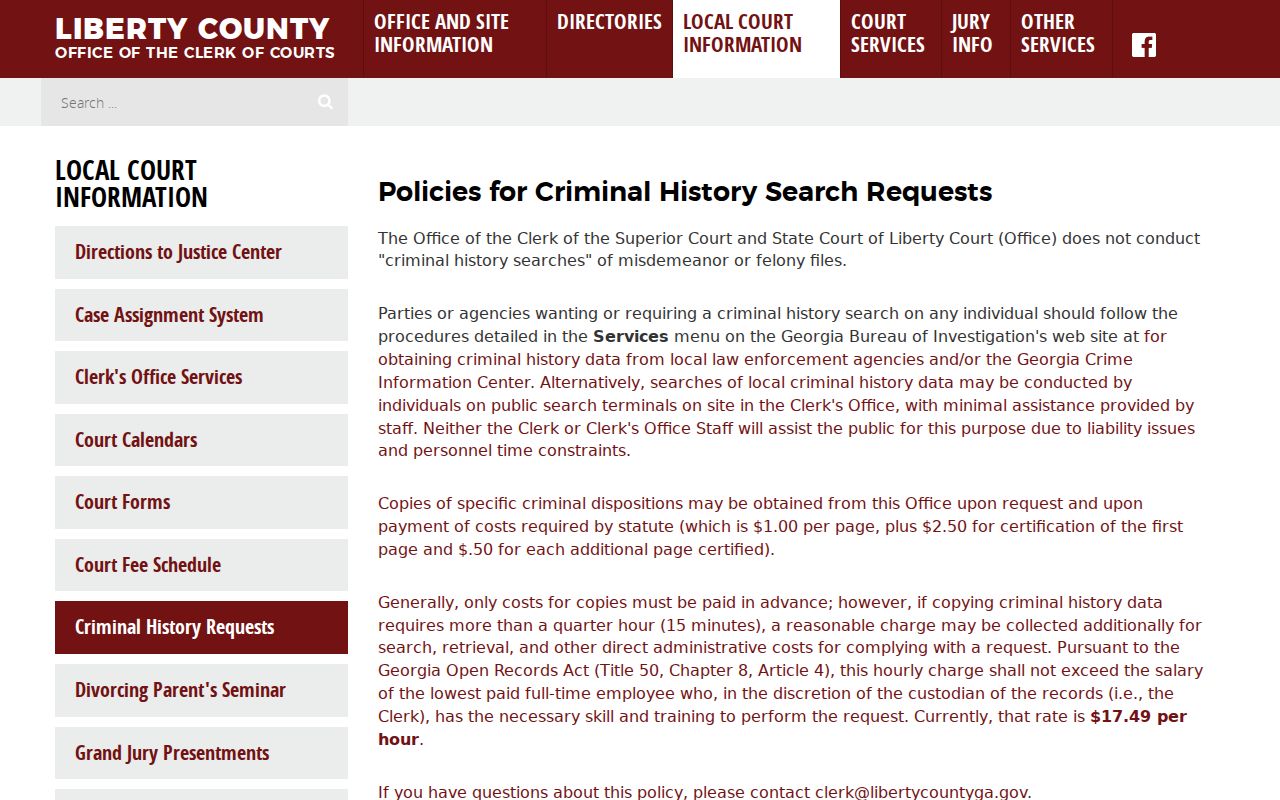
Bring a specific case reference when you order. Expect to pay the copy or certification cost if you need a formal disposition.
Current published costs: a criminal disposition runs $1 per page. Certification adds $2.50 for the first page and $0.50 for each added certified page. Retrieval past 15 minutes has conflicting figures on two current official county sources, so ask the clerk to confirm that charge before you order. Confirm mail and fax details the same way, since county pages differ on them. Phone, email, counter service, and the public terminal remain the fallbacks the county documents.
Liberty County Criminal Docket Assignment
How does a criminal case land with a judge in Liberty County? The local assignment rules cover Superior Court cases. They send civil and criminal cases out by random or rotational procedures. Related matters stay together when practical. The Clerk's part is ministerial. The office processes the assignment but never picks a judge based on who the parties are or what the charge is.
The Liberty case-assignment order holds the official local text of these rules.
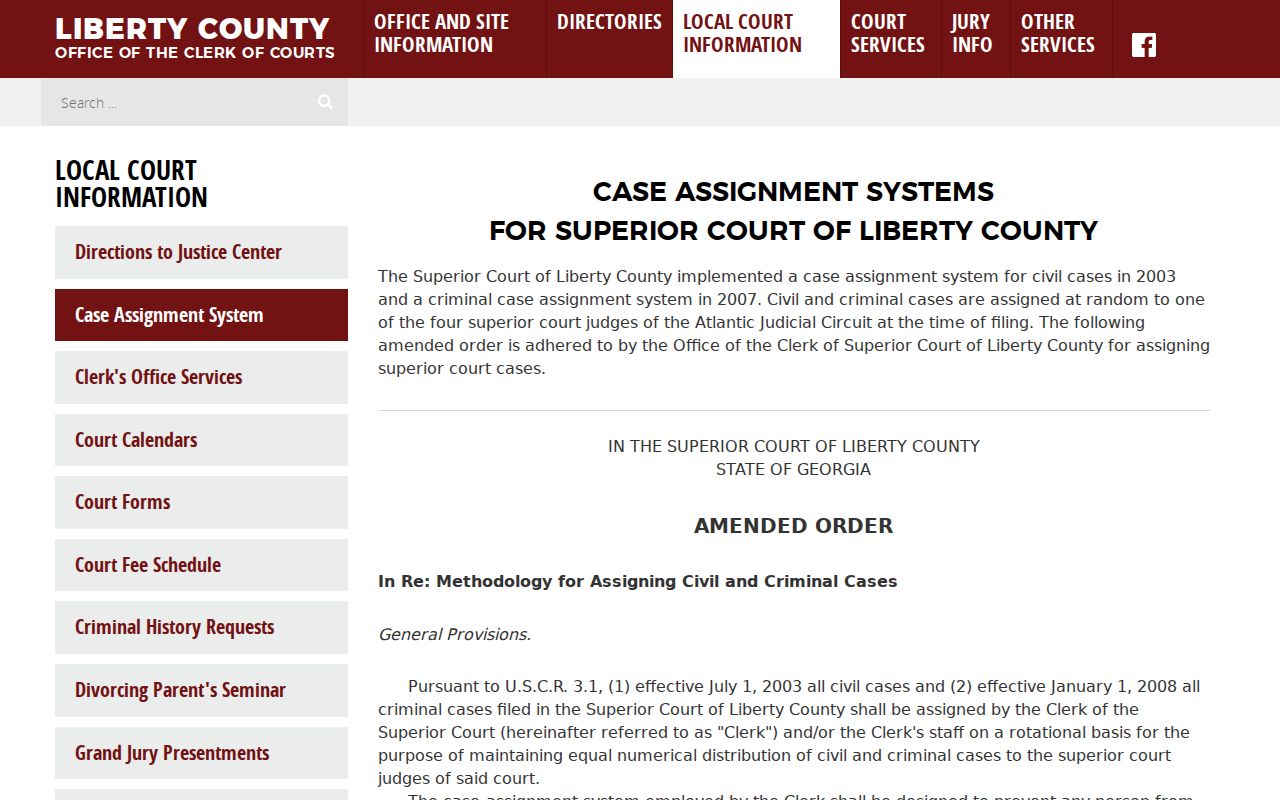
This assignment record shows why the Liberty County criminal docket carries a judge field at all. The docket number and its related-case links stay central to tracking the file, and the judge entry tells you where the case sits.
Sealed Dockets and Public Access
Georgia court files are open as a rule. Still, law or a valid court order can limit access. Uniform Superior Court Rule 21 governs limits on court-file access. Rule 21.6 covers protected identifiers and sealed filing pages. Juvenile files stay confidential or access-limited. Adoption files and some protected family material may stay off the portal. Sealed cases and sensitive document images may not surface through the Liberty County criminal docket portal either.
A blank search result has other causes too. The matter might be municipal or too old for the web layer. It could be indexed under a different spelling. Or it may be filed under a different year and court code. Try name variants first. Then use the public terminal or ask the responsible clerk which court holds the record. Never ask staff to bypass a seal. Georgia's Attorney General also notes that court records follow court-specific access rules. They do not follow the ordinary administrative route of the Georgia Open Records Act.
Key access rules:
Uniform Superior Court Rules 21 and 21.6 set the process for limiting access and protecting private identifiers.
Georgia Attorney General court-record guidance explains why court inspection procedures differ from routine agency records requests.
O.C.G.A. §§ 15-6-60.1 and 15-6-61 duties support the Clerk's custody and docket work.